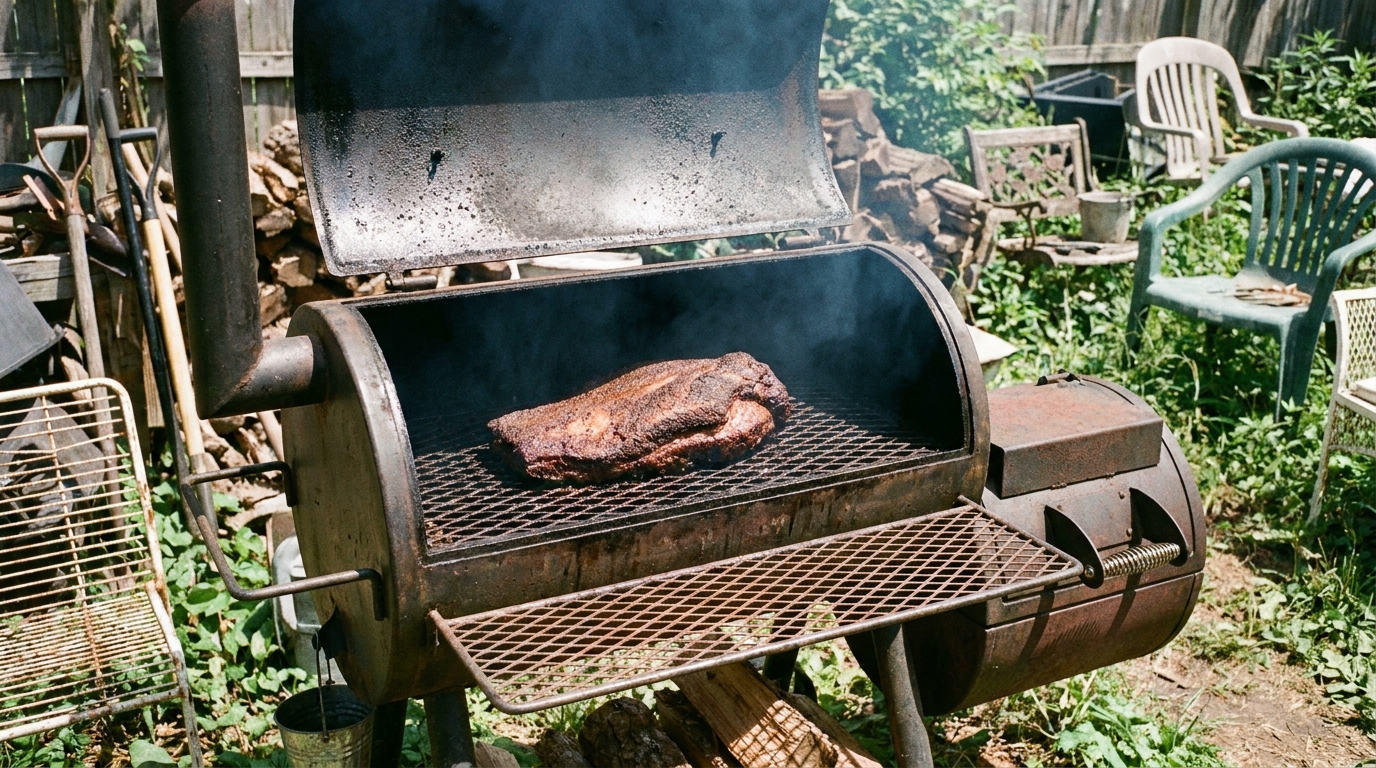
Fat Cap Up or Down on Brisket? A Backyard Offset Answer
Big B’s Quick Hits (TL;DR)
- Shield and Render: The fat cap is not a gravy boat. It shields lean meat from harsh heat and slowly renders. It does not “baste” the packer from above.
- Heat Comes From the Side: On a backyard offset, fire lives in the firebox, not under the grate. Cap orientation follows that heat, not a kettle-grill rule.
- Trim First: Shave the cap to about ¼ inch before you argue up or down. A thick untrimmed slab will not render no matter which way it faces.
- Offset Default: Face the fat cap toward the stronger heat — usually the firebox side — so the lean flat has a shield.
Ask ten pitmasters whether the fat cap goes up or down on a brisket, and you will get ten answers delivered like gospel. One camp swears the fat bastes the meat as it melts. Another camp on a pellet-grill forum will tell you the opposite with the same confidence. The argument stays loud because those cooks are not standing in front of the same pit.
On a backyard offset, heat does not rise evenly from below the grate. It rolls out of the firebox, across the chamber, and out the stack. That changes what the fat cap is for. This post is about grate orientation — which way that cap faces once the packer is on the cooker — not how to trim it. For the knife work and the ¼-inch target, use trimming a packer brisket. For the full cook from fire to rest, start with Brisket 101.
What the Fat Cap Actually Does
The fat cap is the subcutaneous fat layer on the outside of a packer brisket. On the grate, it does two jobs: it shields the lean from harsh radiant heat, and it slowly renders from a firm white slab into a translucent, buttery layer that helps the bark set. That is the whole job. It is not a self-basting gravy pump dripping flavor through the muscle like a roast in a pan.
The baste myth is the loudest piece of forum dogma, and it falls apart the second you think about gravity. Melted fat runs downhill. If you park a thick cap on top of the packer and wait for it to “baste” the flat, most of that liquid slides off the sides and into the drip pan, not through dense beef. Rendering still matters — well-rendered fat tastes rich, and unrendered fat chews like a rubber eraser — but the melt has to happen in a layer thin enough to finish during a low-and-slow cook. A ¾-inch untrimmed cap will still be waxy at slice time no matter which way it faced.
That is why trim comes before orientation. You want a uniform cap around ¼ inch across the flat: thick enough to protect the lean, thin enough to render and fuse with salt, pepper, and smoke into bark. How you get there lives in the trim a packer brisket walkthrough. This post assumes that work is already done. If you skip it and throw a cryovac packer on the grate fat-side-whatever, you are arguing about a shield that is too thick to do its job.
Once the cap is shaved, orientation is about putting that shield where the heat is strongest. Rendered fat also keeps the surface glossy enough for bark to lock on, which is why a bald flat dries gray and a ¼-inch cap turns mahogany. You are not choosing “up” or “down” as a personality. You are placing a thin layer of insurance between the lean and the hottest air in the chamber.
Heat Direction: Offset vs Kettle vs Pellet
The “up or down” fight is really a cooker fight wearing a brisket costume. Heat does not arrive the same way on every pit, so a rule that works on a kettle can wreck a packer on a stick burner. Before you copy a forum default, ask where the fire actually lives.
On a backyard offset smoker, the fire sits in a firebox on the side of the cooking chamber. Heat and smoke enter from that opening, roll across the grate, and exit the stack. The side closest to the firebox is a radiant hot spot. The chimney end runs cooler. Airflow is horizontal, not a column rising from charcoal under the meat. That is why “fat cap down, toward the coals” is the wrong mental model for this pit. There are no coals under the brisket. The threat is the firebox wall and the draft washing across the lean flat.
Kettles and snake-method cooks are a different geometry. Charcoal often sits under or around the grate, so heat rises from below. In that setup, a fat cap facing down can act as a shield between the coals and the meat, which is why kettle pitmasters sound so sure about fat-down. They are protecting the packer from a heat source that an offset does not have. Copying that advice onto a stick burner puts the shield on the wrong side of the problem.
Pellet grills muddy the argument further. A pellet cooker is closer to an even convection oven with a smoke flavor. Heat is more uniform around the chamber, so orientation matters less than it does on an offset with a hard hot side. Plenty of pellet cooks run fat-cap up because it looks right on the grate and still renders at 225°F–250°F (107°C–121°C). That is a reasonable pellet call. It is not proof that offsets should do the same. The conflict online is three different heat maps arguing as if they share one grate.
Big B’s Default on an Offset
Once the cap is ¼ inch and you know where the heat is coming from, the backyard call is simple. You are protecting the lean flat, not performing a ritual. The fat cap goes where the fire is harshest, and the thick point goes where the chamber runs hottest.
Big B’s Take: On a backyard offset, I face the fat cap toward the stronger heat — usually the firebox side — so the lean flat has a shield. I am not chasing a forum “up” or “down.” I am putting that thin layer of insurance between the meat that dries out first and the hottest air in the chamber.
On most stick burners, that means the fat cap looks “up” from the lid, because the fire is beside the grate, not under it. The cap still needs to face the firebox wall and the incoming draft, not the cool chimney end. Pair that with the other offset habit from mastering the offset smoker: put the thick point closer to the firebox and the thinner flat toward the stack. The point can take the extra radiant heat. The flat cannot.
Leave it there. Flipping a packer mid-cook to “even things out” sounds tidy and usually costs you bark and pit temperature. Every lid-open flip dumps heat, smears a half-set crust, and puts the shield on a new side after the meat has already started rendering in one direction. If one edge of the flat is getting too dark, shift the whole packer an inch or two toward the cooler end, or rotate it so the point still faces the firebox. Do not flip it like a burger. This is the default I use on a low-and-slow cook at 225°F–250°F (107°C–121°C), the same window as Brisket 101.
When to Break the Rule
A thin cap after an aggressive trim changes the call. If you skinned the flat bald or left only a paper-thin film, there is no shield left to orient. In that case, watch the lean like a hawk and be ready to shift the packer toward the cooler end of the grate. The better fix is still the ¼-inch trim, not a clever flip. Orientation cannot replace fat you already cut away.
Pellet and kettle cooks can ignore the offset default without being wrong. On a kettle with coals below, fat-cap down toward the heat is a sensible shield. On a pellet grill with even convection, fat-cap up is fine if it renders. Do not import those habits onto a stick burner just because a video looked confident. Match the cap to the heat map you actually have.
Hot-and-fast is the other exception. If you are running the pit closer to 275°F–300°F (135°C–149°C) instead of a classic 225°F–250°F (107°C–121°C) low-and-slow, radiant heat on the firebox side gets meaner, and a thin cap can scorch before it renders. Face whatever fat you have at that hot side even more deliberately, and be ready to shift the packer toward the stack if the bark on the firebox edge goes from mahogany to charcoal. Speed does not cancel geometry. It just shortens the window to fix a bad orientation.
Wrap timing is a separate decision. Orientation does not tell you when to wrap, and wrapping does not fix a cap that faced the wrong heat for six hours. Put the packer on the grate with the shield in the right place, then let bark, render, and the stall tell you when paper or foil earns its keep — the full decision lives in when to wrap a brisket. Do not flip the packer at wrap time either. Wrap it in the same orientation it cooked in.
Keep the fire steady and the drinks cold. I’ll see you at the pit. - Big B
Keep the Fire Burning
How to Slice a Packer Brisket Against the Grain
Rest first, then follow the grain as it turns. Pencil-thick slices on the flat, rotate at the point, and keep bark on every piece.
Read GuideWhen to Wrap a Brisket: The Pitmaster's Timing & Decision Guide
Stop wrapping by the clock. Learn how bark formation, fat render, and temperature cues tell you the exact moment to wrap your packer brisket.
Read GuideSpritz vs. Mop on Beef: Moisture, Bark, and Timing Guide
Should you spray apple cider vinegar or brush on a rich mop sauce? Learn how spritzing and mopping affect bark, temperature, and flavor on smoked beef.
Read Guide