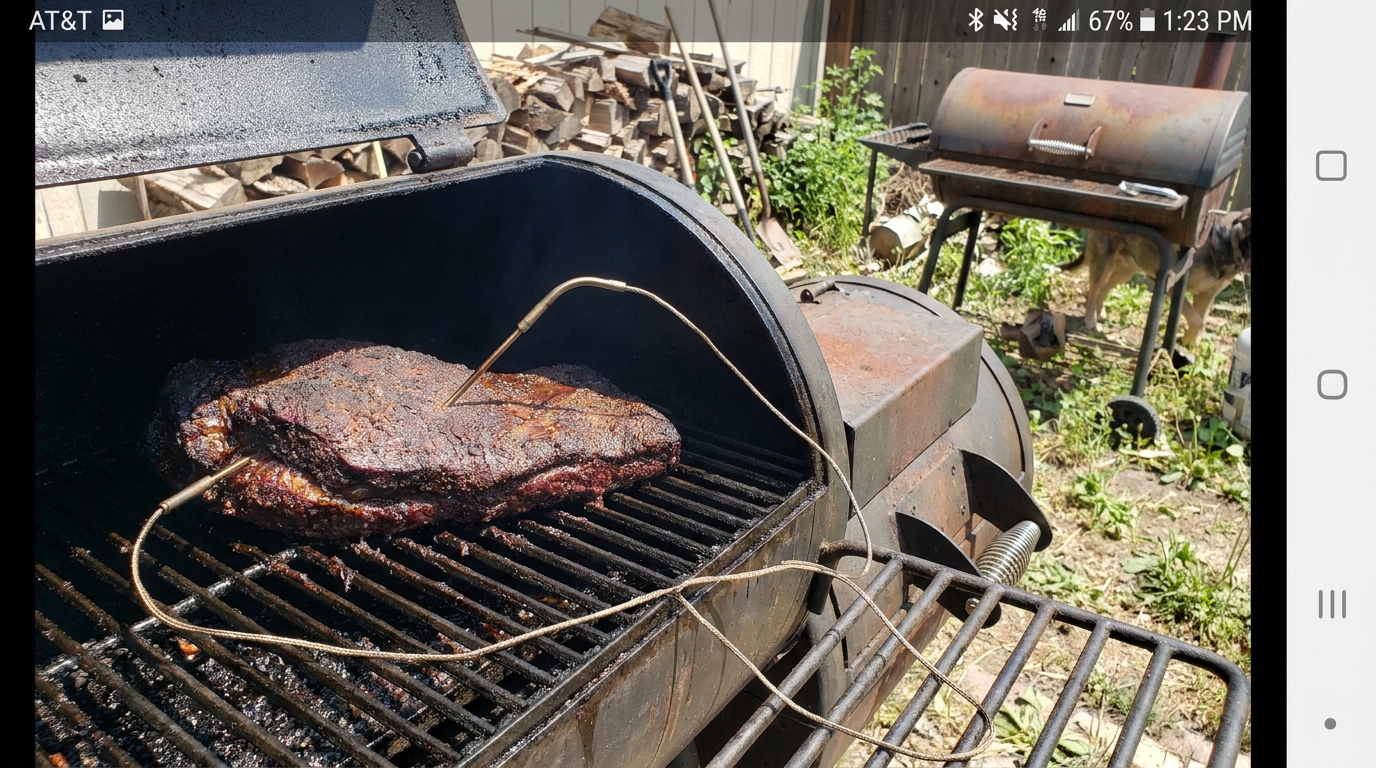
Where to Place Leave-In Probes on Brisket and Pork Butt
Big B’s Quick Hits (TL;DR)
- The tip is the sensor: Fat seams and bone read hotter than the lean. Place the thermistor in the danger zone, not the easy zone.
- Brisket: thickest flat, miss the deckle: The lean flat dries first. Keep the probe out of the fat seam between point and flat.
- Pork: center mass, not against bone: Bone conducts heat and lies. Aim for the thickest meat, often the money muscle.
- Finish by feel: 203°F (95°C) is a rumor if the tip sits in tallow. Pull when it is probe-tender.
You trimmed a packer, set the offset to 225°F (107°C), and waited for the display to hit 203°F (95°C). You sliced the flat and it ate like a boot. The probe was not “wrong” in the ice-bath sense. The tip was sitting in a river of rendered tallow, reading a number that had nothing to do with the lean.
A leave-in probe only tells the truth if the thermistor sits in the part of the meat that finishes last and dries first. That is placement, not calibration. If you have not checked the probe itself, start with How to Calibrate Your Smoker’s Leave-In Temp Probes. Then come back here and put the tip where it belongs.
This walkthrough covers packer brisket (thickest flat, miss the deckle) and pork butt (center mass, not against bone), plus how to run a pit probe without letting it kiss hot metal. The number on the screen is a checkpoint. Tenderness is the finish line.
Why Placement Beats the Number
The heart of a leave-in probe is a thermistor packed into the last few millimeters of the metal tip. Everything behind that tip is just a handle and a cable. If the tip sits in a fat seam, against bone, or only a half-inch under the bark, the display is reporting that tiny neighborhood, not the cook as a whole.
Fat and bone lie in opposite, equally unhelpful ways. Rendered fat and tallow run hotter than the adjacent lean once the cook is rolling, so a tip buried in the deckle or a pork fat pocket can read 203°F (95°C) while the muscle next to it is still chewing through collagen. Bone conducts heat faster than meat. Park the tip against the blade bone in a pork butt and you will think you are done when the center of the shoulder is still tight.
Internal temp is still the right language for the cook. You want a number from the thickest, leanest danger zone, then you confirm with feel. Time charts and “pull at 203” folklore assume the probe is in that zone. If it is not, the folklore is just a rumor with a decimal point.
Big B’s Take: I would rather have a slightly cheap probe in the right spot than a fancy one in a fat seam. Placement is the skill. The transmitter is just the scoreboard.
Brisket: Thickest Flat, Miss the Deckle
On a packer, the lean flat is the dry risk. The point has more intramuscular fat and will stay juicy even if you overshoot a little. The flat is a thinner muscle with less insurance. Put the leave-in tip into the thickest part of the flat, coming in from the side so the sensor sits dead-center in the lean, not under the fat cap and not riding the surface bark.
The trap is the deckle and the fat seam that joins the point to the flat. That seam looks like an easy insertion path. It is also a river of tallow once the cook gets into the stall. If the tip rests there, you will see a confident 200°F (93°C) while the lean flat is still in the 180s°F (around 82°C) and nowhere near probe-tender. Angle past that seam. You should feel lean resistance as you slide the probe in, not a greasy empty pocket.
Insert until the tip is at least an inch and a half into the muscle, then check that the cable can exit toward the cooler side of the pit without draping across the firebox end. On a full packer, an optional second probe in the point is useful if you like to know when the fatty end is rendering, but the pull decision still belongs to the flat. For the rest of the cook, wrap, and rest, follow Smoked Brisket 101.
Big B’s Take: If I only get one probe in a packer, it goes in the thick flat every time. The point will wait. The flat will not.
Pork Butt: Center Mass, Not Against Bone
A bone-in pork butt looks like it gives you a built-in target: slide the probe along the blade bone and call it a day. Do not. Bone heats faster than the surrounding muscle, so a tip kissing the bone reads high and early. You will pull a shoulder that still has tight collagen in the center while the display is already celebrating.
Find the thickest mass of meat. On many butts that is the money muscle (the spinalis, the cylindrical lobe on the side opposite the bone). Come in from the end or the side so the tip sits in the center of that mass, well clear of the bone and well clear of the heavy fat cap. You want lean pork around the sensor, the same way you wanted lean flat on the brisket.
If the butt is boneless, treat the geometric center as the danger zone. Push the probe in until the tip is buried, not parked just under the bark. A shallow reading cooks with the surface and will race ahead of the interior. For fire timing and the overnight hold, use The Overnight Pork Butt. This post is only about where the metal goes.
When the number on the pork is in the 195°F to 205°F (91°C to 96°C) range, stop staring at the transmitter and do the bone wiggle plus a probe-tender check in a couple of spots. The leave-in probe got you to the window. Feel decides the pull.
Pit Probe vs Meat Probe, and Common Misses
You need two different jobs covered. The meat probe lives in the lean danger zone. The pit probe lives at grate level, in the air next to the meat, measuring the cooker. Clip the pit probe so the tip hangs in the airstream about an inch off the grate, on the same side of the pit as the meat. Do not let the tip rest on the grate, the water pan, or the steel wall. Metal runs hotter than the air your brisket actually sees.
Route both cables with the same care you give the fire. Bring them out toward the cool end of the offset, not across the firebox. Leave slack so a lid close does not pinch the braid. A pinched cable is how a calibrated probe starts lying mid-cook. Keep the kit organized so you are not yanking tangles at 4 a.m. The box setup in Build a Backyard Probe Organizer Kit is the habit that keeps placement from turning into a broken-wire problem.
Common misses are almost always the same three. Too shallow: the tip sits in bark and reads pit temp dressed up as meat temp. In the fat: the display jumps past 200°F (93°C) while the lean is still tight. Against bone or against the grate: heat conducts in and you pull early. If the number and the feel disagree, trust the feel and re-seat the probe. Recalibrate when you suspect the sensor, not when you suspect the location. That is still the ice-bath and boil check, not a placement fix.
Finish probe-tender. On brisket, a thermometer or skewer should slide through the thick flat like warm butter, with no rubbery grab. On pork, the same slide plus a blade bone that wiggles free. 203°F (95°C) is a neighborhood, not a street address. The rest period is where the juice settles. Do not rush the pull because a badly placed tip got impatient.
Keep the fire steady and the drinks cold. I’ll see you at the pit. - Big B