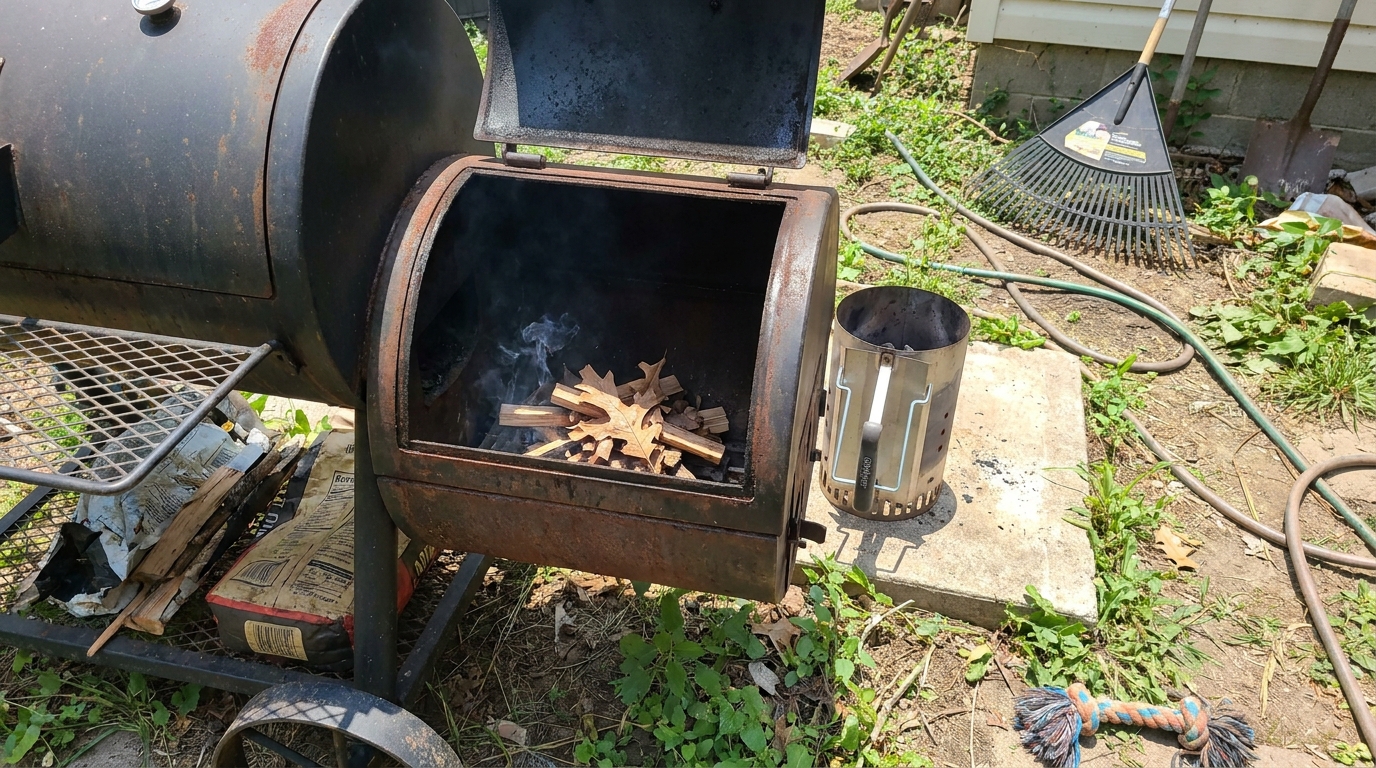
How to Light a Cold Offset Smoker and Stabilize Clean Heat
Big B’s Quick Hits (TL;DR)
- Clear the ash first: Leftover ash chokes airflow and turns a cold start into a smolder.
- Build a coal bed: Light a chimney of lump charcoal and dump it against the intake before any logs go in.
- Small hot fire: Wrist-thick splits, preheated on the firebox, in a crosshatch—not a smothered pile.
- Meat last: Wait for thin blue smoke and a stable 225°F–250°F (107°C–121°C) before the packer hits the grate.
A cold offset smoker is just a steel box full of leftover ash and yesterday’s moisture. Dump a packer on that grate and the first hour of the cook is white smoke, a climbing pit that never settles, and bark that tastes like a campfire that never quite caught. The meat is not the problem. You lit the pit and loaded it before the fire was ready.
Stabilize first. Clear the ash, build a glowing coal bed, add small hot splits, and wait until the stack is thin and the cooking chamber holds 225°F–250°F (107°C–121°C). Then—and only then—does the meat go on. This is the cold-start sequence. It is not the overnight sleep cycle, and it is not a mid-cook rescue. It is how you get a clean fire before the cook even starts.
Step 1: Clear Ash and Set the Vents
Open the firebox and cooking chamber and scrape yesterday’s ash out of both. Ash packed around the firebox grate and under the cooking grates blocks airflow. A cold start on a choked grate is a smolder waiting to happen: the fire cannot pull oxygen, splits sit in grey dust, and the stack pours white smoke before you have even added wood. Dump the ash into a metal can, not a plastic bucket, and make sure the firebox grate is fully visible and sitting level.
Set the vents before you light anything. Open the chimney (the stack) all the way and leave it there for the entire start. The stack is exhaust, not a damper. Choking it to “hold heat” on a cold pit traps dirty smoke in the chamber and starves the fire of draw. Open the firebox intake most of the way—at least three-quarters on most backyard offsets. You want a strong pull of air across the coal bed so the first splits catch hot instead of sitting and steaming.
Big B’s Take: Control temperature with fire size, not a pinched stack. If the pit runs hot later, use smaller splits or wait longer between adds. Closing the chimney on a cold start is how you get bitter bark before the meat even goes on.
Give the steel a minute of empty airflow while you light the chimney. A pit that sat overnight is damp on the inside walls even if the weather looks dry. That moisture has to leave through the stack before you will ever see clean smoke. You are not cooking yet. You are opening the pipe so the fire can breathe.
Step 2: Build the Coal Bed
Light a full chimney of lump charcoal with no lighter fluid. If you need the lighting method, use the chimney start without lighter fluid walkthrough and come back here when the top coals are ashed over. You want a glowing, grey-edged coal bed—not a cylinder of black lumps with a flame at the bottom. Dumping too early means the first splits sit on half-lit fuel and smolder.
Pour the hot coals into the firebox against the intake vent, not in a thin scatter across the whole grate. A concentrated mound next to the draft is a thermal core. Air hits that pile first, the coals stay together, and the next split has a hot face to land on. Rake them into a bed about two inches (5 cm) deep on the intake side, with a little room on the far side of the firebox so you can add wood without burying the coals.
Do not add logs yet. The coal bed is the ignition source. Wood on a weak, just-dumped pile steams, puts out white smoke, and cools the firebox instead of lighting. Give the coals two or three minutes in the open firebox with the intake wide so they recover from the dump. You should see orange through the pile and feel hard heat on your face when you stand at the door. That is the base. Splits come next.
Step 3: First Splits and Preheat Wood
Start with two wrist-thick splits of seasoned post oak, not a round of firewood that still has bark and sap. Thick logs on a cold start smother the coal bed. Thin, dry splits catch on the hot face, burn with flame, and feed the chamber instead of filling it with steam. If your oak is still cool from the shed, set the next two pieces on top of the firebox lid or along the firebox wall so they pick up heat before they go in.
Lay the first two splits in a loose crosshatch over the coal mound—one across the intake draw, the second crossing it so air can still move through the pile. Do not stack them parallel and tight. A packed firebox is a smolder. You want flame licking the split faces within a minute or two, not a log sitting in grey smoke. Leave the firebox door shut after the add so the draw pulls through the intake, not out the door.
This is the same small-hot-fire idea as mastering the offset smoker: you are not building a bonfire. You are lighting just enough wood to heat the steel and clean up the stack. If the flames die and the splits sit there hissing, pull one piece out, open the intake fully, and let the coals recover before you try again. A cold, wet split will not catch no matter how much you want the cook to start.
Step 4: Wait for Thin Blue and a Stable Pit
Walk to the chimney, not the firebox door. You are looking for blue smoke: thin, almost invisible, with a faint blue tint in sunlight. Thick white or grey billows mean the wood is still driving off moisture and unburned gases. That smoke will coat the meat. Leave the chamber empty until the stack thins out and the smell at the chimney is clean wood fire, not steam and creosote.
Watch the cooking-chamber thermometer, not just the firebox. Target 225°F–250°F (107°C–121°C) and hold it there. A spike to 300°F (149°C) on a cold pit is the steel catching up, not a stable cook. Wait until the needle settles in the window for at least 15 to 20 minutes with only small, hot adds. If it keeps climbing, you have too much wood on the coals. If it will not break 200°F (93°C), the fire is too small or the coal bed died—add a split only after you see flame, not because the number is low.
Give the steel time. A cold offset is a heat sink. The walls, the grates, and the water in the metal all steal energy from the first fire. Rushing meat onto a 225°F (107°C) reading that just got there usually means the temp drops the second you open the door. When the pit holds the window, the stack is thin, and a new split catches with flame instead of smoke, the start is done. Now you can cook.
Step 5: Load Meat and Common Cold-Start Failures
Put the meat on only after the pit is stable and the stack is clean. Open the cooking-chamber door, load quickly, and shut it. Expect a short temp dip—cold meat and an open door will do that. Do not panic-add a fat log to “catch up.” Let the existing fire recover. If you are running a long overnight cook later, that is a different routine: see managing an overnight fire on an offset. This start is just getting you to a clean, steady pit before the first hour of smoke.
White smoke that will not thin after 20 to 30 minutes is almost always wet wood, a smothered coal bed, or a choked stack. Open the intake, pull any splits that are sitting without flame, and let the coals burn down until you see orange again. Then add one small, preheated split. If the smoke stays dirty once meat is on, stop treating it as a start problem and use the dirty smoke on an offset reset. Do not keep feeding logs into a white stack hoping it will clear.
Temperature spikes over 275°F (135°C) on a cold start usually mean too much wood at once. Let it burn down. Do not close the chimney. A dying fire—temp sliding under 200°F (93°C), splits going dark, no flame—means the coal bed was too thin or you added wood before the coals recovered from the dump. Light another half chimney if you have to. Rebuild the glowing base, then go back to small hot splits. The cook starts when the fire is right, not when the clock on the fridge says it should.
Keep the fire steady and the drinks cold. I’ll see you at the pit. - Big B